In a fast-moving world, suffused by conflict and political uncertainty, it might seem odd for the UK government to surrender sovereign British territory in a distant sea.
Indeed, the government’s critics go further and say the decision to give up a key strategic foothold in the Indian Ocean is a dangerous weakening of UK security.
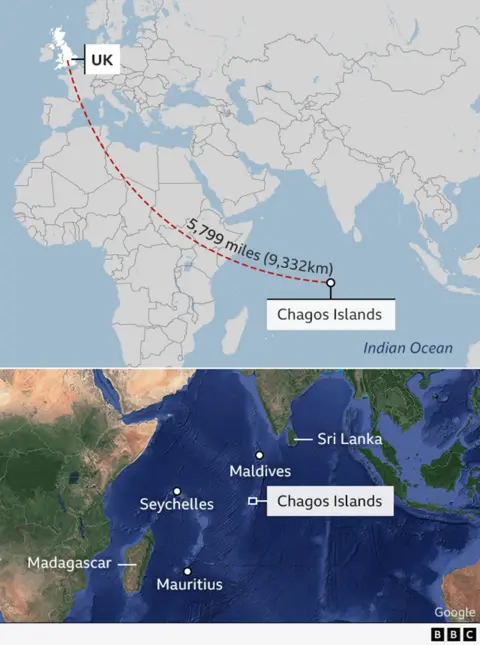
So why has the government handed the Chagos Islands to Mauritius, a nation some thousand miles away?
The answer has a legal origin and a practical conclusion.
It all focuses on the joint UK-US military base on the biggest island in the archipelago, Diego Garcia.
The government felt that without ceding sovereignty to Mauritius, the operation of the base would become unworkable and that would pose a greater threat to UK security.
Defence Secretary John Healey told MPs that “without this deal, within weeks, we could face losing legal rulings and within just a few years the base would become inoperable”.
The putative legal challenge is based on a series of judgements by various United Nations bodies that the Chagos Islands belong to Mauritius.
Essentially, they argued the UK had no legal right to separate the islands from Mauritius before the former British colony became independent in the 1960s.
There were votes to that effect in the UN General Assembly.
But then in 2019 there was an “advisory opinion” by the UN’s International Court of Justice backed up by a later ruling of the Special Chamber of the International Tribunal for the Law of the Sea.
Ministers feared these rulings and opinions would soon become a legally binding judgement by this UN tribunal.
Under pressure in the House of Commons to identify the source of this legal threat, Healey said: “There’s a range of international legal challenges and rulings against us.
“The most proximate, the most potentially serious, is the tribunal of the International Convention of the Sea.”
If the government lost a case there, ministers argue, the outside world would be obliged – by law – to take decisions that would interfere in the running of the base.
So they argue Diego Garcia’s satellite communications would be threatened because the UK relies on a UN authority in Geneva to get access to a particular electromagnetic spectrum.
They say contractors would refuse to visit the isolated base – to make repairs or deliver supplies – for fear of being sued by Mauritius.
The ability to fly aircraft in and out might be challenged by international rules that govern our skies.
The government’s critics – which include Conservative and Reform MPs, some foreign diplomats and even a few officials within Whitehall – challenge this argument and say the legal threat is being exaggerated.
They accuse ministers of being overly submissive to international lawyers and craven to politically motivated votes at the UN.
Shadow defence secretary James Cartlidge told MPs the government was “following the legal advice to act definitively to our detriment, entirely on the basis of hypothetical risk that has not yet materialised and which we could challenge”.